

Magical Navigation: Writing Magic into the Australian Landscape
Tara East explores Robbie Arnott’s use of magic in Flames and The Rain Heron

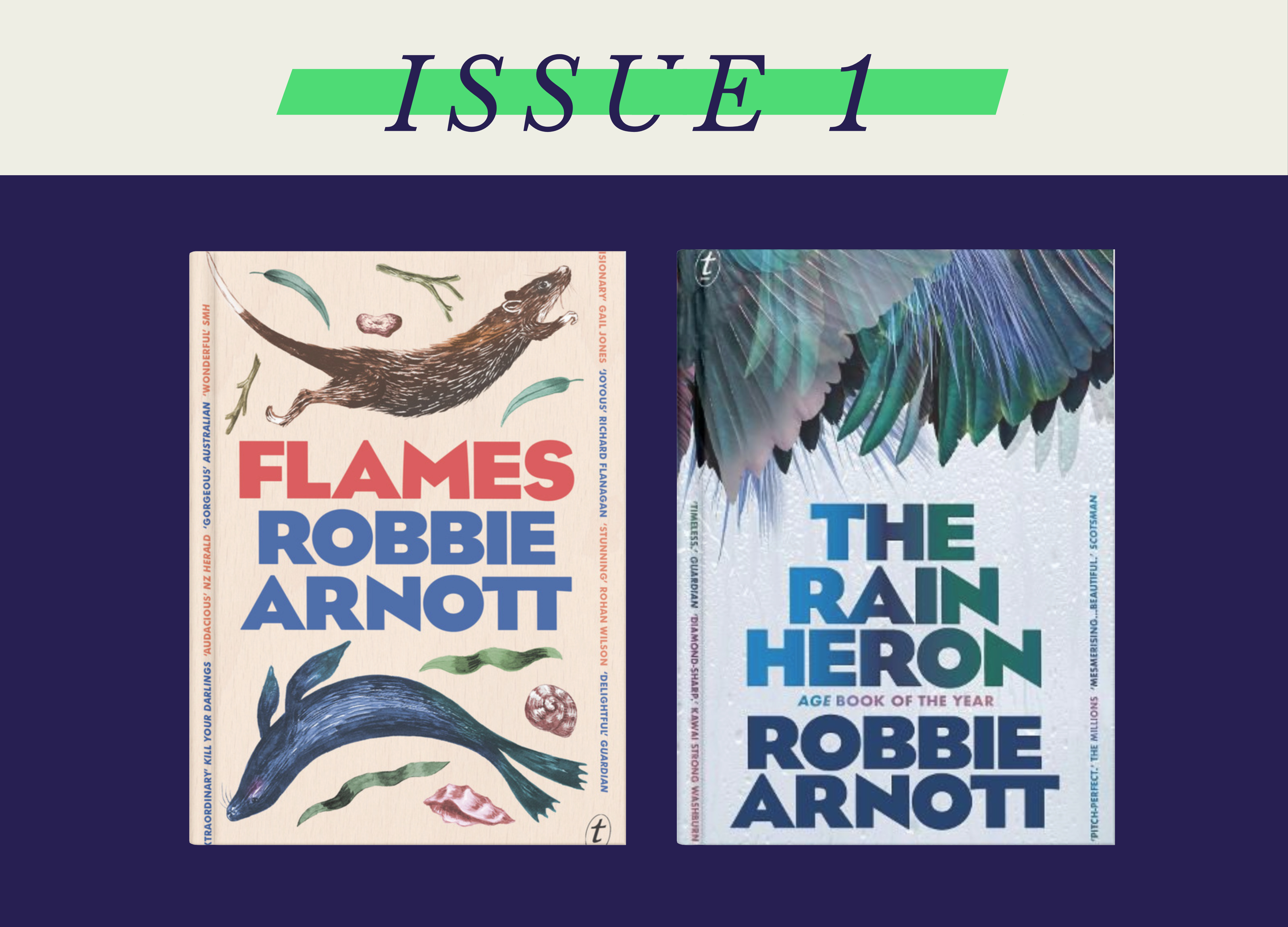
Tasmanian author Robbie Arnott is not afraid to incorporate magic into his Australian literary texts. Without context, that statement may sound insignificant. After all, we have a wealth of Australian authors who engage with folklore, mythology, and fairy tales.
However, as creative writing scholar Danielle Wood points out, most Australian writers who work in this space fall into one of two camps. The first are writers interested in retelling stories from the European tradition usually using a European setting or imaginary world. The second are writers who incorporate aspects of the European tradition into a contemporary Australian setting (Wood, “Writing Baba Yaga”). In these cases, the author is writing what we’d describe as an original fairy tale.
Robbie Arnott neatly falls into this latter, significantly smaller, camp. But before we get to Arnott and his works, I’d first like to clarify what I mean by folklore, fairy tale, and original works.
Folklore researchers Martha Sims and Martine Stephens provide the following helpful definition:
Folklore is informally learned, unofficial knowledge about the world, ourselves, our communities, our beliefs, our cultures and our traditions, that is expressed creatively through words, music customs, actions, behaviors, and materials. (8)
Within folklore narratives, we have four key genres: myths, legends, fables, and fairy tales. For the purposes of examining the use of magic in Arnott’s work, I will only be focussing on fairy tales. Fairy tales, like folklore, are difficult to define and many of these definitions are contradictory and contested. It is often easiest to define a fairy tale against the other folklore genres of myth, legend, and fable, but for the sake of ease and simplicity, I will be using creative writing and fairy tale scholar, Nike Sulway’s definition. Fairy tales could be described as fictional stories that occur in a non-specific time, in a world that is similar to our own, only it contains magic, and the main characters are human.
As Wood explains, Australian writers in this space usually produce either European retellings or original works that incorporate aspects of the European tradition (Wood, “Writing Baba Yaga”). A retelling refers to any work that is recognisably based on or in-conversation with a pre-existing text. For example, Disney’s live action release of Beauty and the Beast is a retelling of the animated film (the two are almost identical), but it is also a retelling of French writer Jeanne-Marie Leprince de Beaumont’s literary fairy tale, which is substantially different. Here, the father plucks a rose from the garden which brings about a bargain that sends Beauty to the Beast’s door. Beauty is lavishly taken care of, and the Beast frequently invites her to join him in bed which she refuses, thinking him ugly. At night though, she dreams of her true love. Eventually, her feelings about the Beast and the man in her dreams come into conflict, and she also becomes tremendously homesick. The Beast presents her with an engagement ring that will immediately transport her home, but she must return within two months, or he will die (Zipes 805).

Fairy tales can be broken up into three different categories: versions, variants, and revisions. A version is simply a recognisable, fairly faithful duplication of a fairy tale. This might be retellings that are almost identical in their use of patterns, values, imagery, and motifs (e.g. Disney’s animated and live action films). A variant is sufficiently different from other variants, making it unique. These changes have been made in response to the cultural context in which the work is being published, or because of stakeholders (tellers, transcribers, editors etc). In this instance, we could say that both Disney versions are a variant of de Beaumont’s original work. Some variants are revisions. A fairy tale revision is aesthetically altered to make the story more appealing to a contemporary audience, but it also changes the traditional tale’s values and meanings or ideological underpinnings and messages. A good example here might be Kate Forsyth’s The Beast’s Garden, which is a revision of Beauty and the Beast. Set in World War Two, the novel focusses on Ava (Beauty) who must marry a young nazi officer named Leo (the Beast), in order to save her father, sister, and niece.
Forsyth is one of many Australian writers who uses non-Australian settings for their fairy tale fiction. Some of her other works include Bitter Greens (2012), which is a revision of Rapunzel, and Beauty in Thorns (2017) is a revision of Sleeping Beauty. Both are set in Europe. Angela Slatter’s The Bitterwood Bible and Other Recounting (2014) and Sourdough and Other Stories (2010) are original fairy tale collections, set in imaginary (though recognisably European) landscapes. Margo Lanagan’s Tender Morsels (2008) is a Snow White revision—also set outside of Australia.
This creative choice to draw on European fairy tales might stem from the writer’s desire to draw upon their cultural heritage, or they simply do not have the impulse to write stories set in Australia. Perhaps it is driven by commerce? A need to make the work more commercially appealing by meeting genre convention so the book can be competitive in a US and UK market (Wilkins; Masson and Hale). Or perhaps this decision is connected to our “cultural anxieties” about our nation’s colonial history (Wood, “Renegotiating” 10). If a writer decides they’d like to write a fairy tale retelling or create their own original fairy tale, set-in Australia, they will inevitably need to figure out how they are going to “manage” our colonial past, and how they plan on representing our violent origins. Will they choose to obscure our past or illuminate it? (Bradford 15; Wood, “Strategic” 10). As a white Australian writer, I too grapple with how to ethically and respectfully represent the landscape and Indigenous Australians, regardless of the genre I’m working in. As Wood goes on to explain:
Generally, it is not considered appropriate for white Australian writers to engage with indigenous Australian mythologies, but it seems to have been equally problematic for white Australian writers to engage with European mythologies on Australian soil and for postcolonial Australia to invent fairy tales of its own. Or, to be slightly less generous, it may be that they wish to avoid being criticized for so doing. (Wood, “Writing Baba Yaga” 161-162)
And yet, some authors are seeking ways to approach this sensitive creative challenge, ways in which they might experiment with ‘“fairy-tale revisionism in an Australian setting” (Wood, “Strategic” 11). Some examples here include Cate Kennedy, Nan McNab, and Maureen McCathy. But for the purposes of this article, I will be discussing Robbie Arnott’s creative work.

Robbie Arnott has released four novels since his debut in 2018. In both Flames (2018) and The Rain Heron (2020), Arnott creates an alternative version of Lutruwita (Tasmania), one in which magic exists. His later novels, Limberlost (2022) and Dusk (2024), also contain elements of magic, but these depictions are comparatively minor. However, I will be focusing on Flames and The Rain Heron as the magic within these stories is inherent to the characterisation and/or plot.
Flames is an unusual novel to summarise. I suppose we can say it’s a novel about a young woman, Charlotte, who inherits the gift of magic from her father, the Fire God. Unfortunately, her brother, Levi, has been possessed by another god, the Esk God, who convinces Levi that he must kill and bury Charlotte to prevent her from rising from the dead, the way the cremated women in their family sometimes do.
The setting of many classic or traditional European fairy tales is often simplified and located in a time and space that is separate from the reader, and in the case of contemporary readers, there is a great distance between us and the location of those fairy tales. Traditional European fairy tales often take place in a recognisably medieval European setting, though the exact location of the characters and actions are never defined, nor the date mentioned. Traditionally, the setting usually acts as a backdrop to the human and magical dramas described, but Arnott privileges and grants agency to the Australian landscape where his novels are set. His stories do not unfold in an imagined space or a flattened version of a familiar landscape, but grounded, firmly, in contemporary Tasmania as indicated through its references not to towns or cities, but specific and recognisable landscapes and natural formations, such as Notley Fern Gorge, Cradle Mountain, and the Tamar Valley.
It is important to note that Arnott is not the first Australian writer to combine fairy tales with a Tasmanian setting. Carmel Bird, an Australian writer who has done an incredibly amount of work with fairy tales, credits her love of fairy tales to her upbringing in Tasmania, saying “[Tasmania] pops up in literature when a writer seeks a far off, inconsequential, mythical or gruesome place to insert the prose” (Fair Game 10) and a place that she, as a girl, experienced as “strange and haunted” (Cape Grimm 11) . Wood says of her own desire to incorporate fairy tale traditions in the Tasmanian bush: “Tasmania is cold, wild, and mountainous: a place deeply haunted by the systemic brutality of its history of colonial dispossession” (Wood, “Writing Baba Yaga” 160).
Overlaying a European fairy tale in Tasmania, then, seems a particularly precarious choice, given the dark and brutal history of the state. As reported by The Guardian, the Indigenous population was roughly 6,000 in the early 1800s, but within a few decades it was just a few hundred.
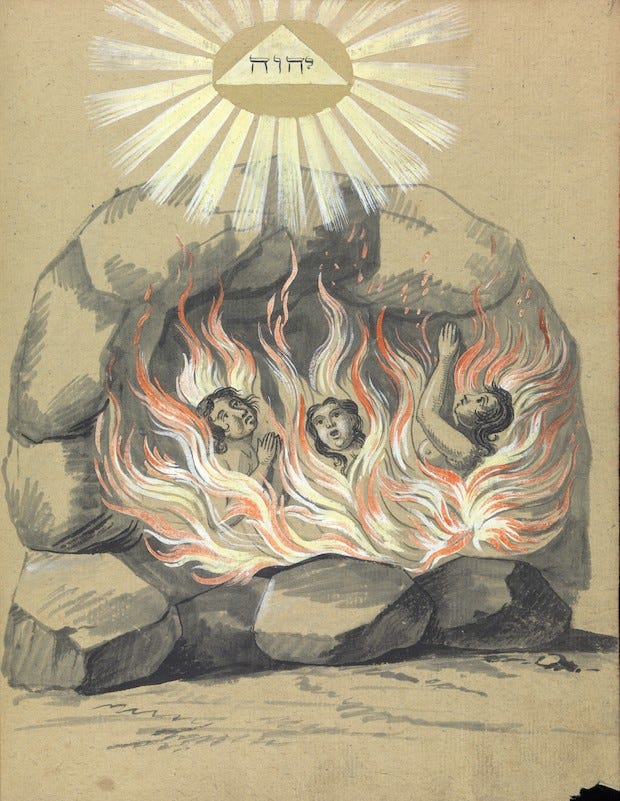
In Flames, Arnott chooses to acknowledge this past through one particular character, the Flame God, and like many characters in fairy tales, he is a shapeshifter. As readers, we witness the Flame God as he discovers and learns how to direct his magical powers, particularly his ability to transform himself from open flame to human. The Flame God quickly assumes his preferred form of an Aboriginal Australian man. Here, Arnott has employed a technique that reminds me of the shapeshifting character in Jane Rawson’s historical novel, From the Wreck (2017), and how this being allowed Rawson, an inhabitant of the country she was born in, to explore a first-person perspective of the refugee experience. In this way, Rawson does what science fiction and fantasy novelists have been doing for decades: reflecting ourselves to ourselves so that, through narrative distance, we are better able to see our social and cultural inequalities and prejudices.
Though there are similarities in Rawson’s and Arnott’s approaches, Arnott does not use the Flame God as a vehicle for exploring an Indigenous perspective. Instead, the character acts as an interloper and silent witness to the events of early colonisation. Through the perspective Flame God, as a pre-contact Indigenous character, we get to witness the arrival of, and gradual settlement of “pale people”. As he watches, the Flame God comes to understand that his presentation as an Indigenous man will be met with hostility and perhaps violence.
But the story does not linger here.

As a reader, I sense Arnott’s desire to acknowledge this part of our dark history, but also his extreme caution in approaching this topic. Any writer attempting to show, acknowledge, or gesture towards an experience outside of their own likely asks the question: who am I to write this story? What is appropriate? Am I being exploitive? Why am I doing this? Any writer sensitive to the issue of cultural appropriation would likely follow the standard advice, outlined by Martu writer and critic K. A Ren Wyld, to do your research and hire a sensitivity reader. Which is good advice, but ultimately, it is up to the writer to decide how this information will be incorporated into their creative decisions, and how that insight will be executed within the story.
In researching for this paper, I quickly learnt that the public reception of Flames was highly favourable. The novel won a Sydney Morning Herald Best Young Novelist award and the Tasmanian Primer’s Literary Award, 2019. It was also shortlisted and long listed for thirteen other literary prizes. Reviews have praised Arnott for his (truly stunning) nature writing and the inventiveness of his novels. Some reviews have commented directly on his handling of our colonial past, and these too have been positive.
Even as I write this, I can feel myself hedging. Perhaps there is a part of me that wants something more from this (small) section of the novel, and yet I also understand Arnott’s careful approach. Would I have felt confident to do anything different? Would it have felt appropriate or respectful? Every novel is bound by its own rules and laws, so perhaps this really was the best approach for this particular story, and for this particular book (Arnott’s debut). It is important to note that Arnott has offered more direct interrogations of our past in his later works. In Limberlost, the main character is taken to task by his two young adult daughters, who recount the violence of invasion and the massacres that followed, and who ask why he never gave the land back to the traditional owners. In Dusk, an Indigenous character, Lydia, twice uses the term ‘you lot’ when addressing the white settler characters, illustrating the escalating tension between Indigenous people and colonisers.
It’s important to note that these are small moments in Arnott’s work, but perhaps that makes sense. None of these books are about colonisation, so it seems Arnott has chosen to acknowledge our context without it becoming the work’s primary focus. Instead, Arnott’s work is concerned with privileging the landscape and creating his own version of Tasmania, one in which magic exists.

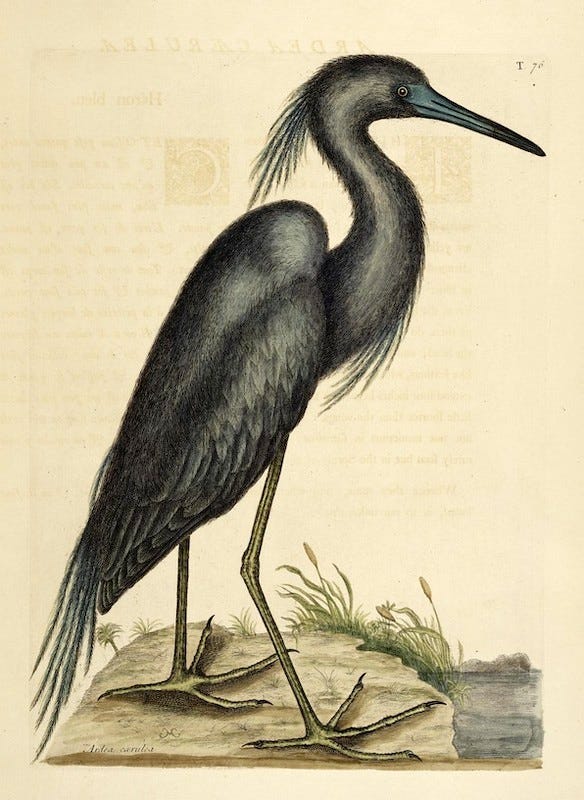
The Rain Heron is set in a future version of Tasmania, one in which a coup has altered our understanding of the state and locals live in fear of the soldiers who patrol the towns and surrounding lands. The novel unfolds almost entirely in the Tasmanian bush as we follow a small cast of characters. The most significant being Harker, a Lieutenant who has been sent into the mountains to find a mythical bird known as, you guessed it, the rain heron, and Ren, a woman who knows where to find it.
The first twenty pages of The Rain Heron (titled Part O) have a distinctly fairy tale-esque quality through the use of an omniscient narrator, a leaning towards telling rather than showing, and a list of characters who are referred to not by name, but their function in the story.
The first character we are introduced to is ‘the farmer’ (later revealed as Ren) who is at odds with the land she manages. Despite doing all that she can to ensure her crops thrive, her property remains barren. Soon though, a great storm arrives, and the source of this unexpected rain is quickly attributed to a bird made entirely from water.
Its blue-grey feathers were so pale they claimed later that they could see straight through the bird. Its body was pierced by strands of dusky light, and the tree was clearly visible directly behind its sharp, moist beak. (Arnott 4)
For reasons that go unexplained, the rain heron finds favour with the farmer, and soon their property is thriving. Unfortunately, this wouldn’t be much of a story if things ended here, and it wouldn’t be much of a fairy tale without a villain. As it turns out, the son of the farmer’s closest neighbour is not pleased by the heron’s blatant favouritism for the farmer. When the boy attempt to kill the heron, the bird, swiftly turns and plucks out his eye before flying away, taking the rain with it.
In this brief section, Arnott quickly establishes one of the work’s themes: the natural world allows magic to exist, and it can use that magic for acts of great generosity, but it can withdraw that generosity just as quickly.
In Part 1, the device of a fairy tale narrative is dropped in favour of contemporary prose. Here, we are reintroduced to Ren (the farmer), who is now living in a cave and tending a small garden of vegetables. The catalyst for the narrative arrives in the form of Lieutenant Harker, who is on a mission to find “The bird. The one that comes from the clouds. The rain heron” (Arnott 43). Ren brushes the bird off as a fairy tale, hoping to fool the soldier, making fun that someone could believe in such tall tales. It seems Harker does think the bird is a fairy tale, but she’s nevertheless been given orders to locate it and return it to her superiors.
In traditional fairy tales, magic is normalised. No one gapes when a beast spontaneously transforms into a prince, or when a magical ring teleports a maiden back home. Arnott deviates from this approach in both Flames and The Rain Heron. Magic does indeed exist within the story and within this landscape, but it is not common knowledge. Only those who have had a direct encounter with it know of its existence. In doing so, Arnott suggests that this nature-based magic is a secret, and if you, dear reader, are not yet a believer, it is only because you are yet to experience it. This tactic offers an interesting work around. Magic is not presented as an accepted fact by the humans who populate these stories. It is quiet, mysterious, and therefore easy to deny.
Although the rain heron is an embodiment of magic, its powers are limited. It can alter the weather, and thereby the fate of all who live in this dried up, drought-ridden state, but Lieutenant Harker is convinced that the bird won’t change anything. In other words, magic is not a solution to our very real environmental (and political) problems. When asked why the General even wants the rain heron, Harkner replies: “Men want things. They hear about something and pretty soon they’re convinced it belongs to them” (167). A comment that suggests the limitations of the rain heron’s abilities, particularly when coming up against human greed, a conclusion that is foreshadowed by the violent intentions of the neighbour’s boy in Part 0.
Though this comment is offered as a broad generalisation about humanity, we can also read it as a reference to colonisation. The Rain Heron is set in Tasmania, but there is no mention of Indigenous people, past or present. Perhaps this is because it is set in a distant, dystopian future. One in which the small cast of (white) characters do not have the capacity to reflect on or engage with anything other than their immediate survival. But we could also read the coup as a metaphor for invasion itself. Rather than the British arriving, we have an un-named military force that has risen with the intention of controlling the population and exploiting the environment.
The novel doesn’t interrogate our colonial past so much as reveal one potential, damning future. The work offers a simple, though perhaps unwelcome conclusion: magic may make things easier for a time, but only people can fix the real problem of humanity’s greed

Flames and The Rain Heron offer us two examples of how a non-Indigenous author might incorporate magic and other aspects of the European fairy tale tradition into an Australian landscape, but there are alternative approaches that other writers are exploring.
Sulway’s personal approach to writing stories in an Australian setting is motivated by the possibility that “reimagining or revisioning fairy tale in the Australian landscape is one way of attempting to think through how we might navigate between our white Western heritages (symbolically linked to Western European fairy tales) and our experience of living on stolen land” (42). Within her practice, she takes an experimental approach in which she combines various traditional narrative forms to illustrate how narrative can obscure, reveal, and preserve information, ideas, history, culture, etc.
Wood has shown concern that the European fairy tale “can’t live in the Australian bush except through risking imaginative violence” (“Writing Baba Yaga” 162). And yet, she doesn’t want to believe this. Instead, she wants to believe that living in a global world, we can use our creativity, imagination, heritage, and tradition to find another way. One that brings “together disparate traditions”. For Wood, this is enabled through the creative prompt of, “What if?”
However, Palyku author and illustrator Ambelin Kwaymullina doesn’t feel it is appropriate for non-Indigenous writers to create works through an Indigenous perspective, particularly as these voices are likely to be privileged above Indigenous voices. When Kwaymullina writes about a marginalised experience that is not her own, she chooses to respect boundaries by writing from an ‘outsider’ perspective and not using first person or third person limited (third person limited grants close access to the protagonist’s thoughts and feelings without being in their mind). Kwaymullina is also a big supporter of collaborative writing (Kwaymullina, “Edges, Centres and Futures”). If a writer wishes to write from the perspective of someone else, they should do so in an inequitable partnership where copyright, royalties, and credit are shared:
“This would not necessarily mean we each wrote half a novel. The other person may not write a word; their contribution could be in opening a window onto insider existence and correcting the mistakes an outsider inevitably makes.” (Kwaymullina qtd. in Leitich Smith)
Across these two works, Arnott offers a way to reimagine fairy tales and mythologies in the Australian landscape. However, he does not simply overlay this existing land with familiar European tales, instead, he has drawn upon the tradition to create his own, unique fairy tale works that are both surprising and inventive. Further, the Australian landscape does not act as a flat background upon which the drama of the novel unfolds. Instead, the natural world is one which enables the magic to exist. In this way, Arnott is not passively using the setting for aesthetic reasons, but crafting characters who literally embody the natural world while also acting as sources for the text’s narrative drive. While non-indigenous Australian writers may continue to feel uneasy about the combining of fairy tales or mythology with the Australian landscape, Arnott’s is just one writer interested in exploring the possibilities.
Click here to view the works cited in this piece
Tara East (she/her) is writer and researcher at University of Southern Queensland where she teaches creative writing. Her research has appeared in The Journal of Writing in Creative Practice, TEXT: Journal of Writing and Writing Courses, and Writing from Below. Her fiction has been published in Andromeda Spaceways Magazine, SWAMP magazine, October Hill Magazine, and TEXT Journal. She is also the author of the mystery novel, Every Time He Dies.
